
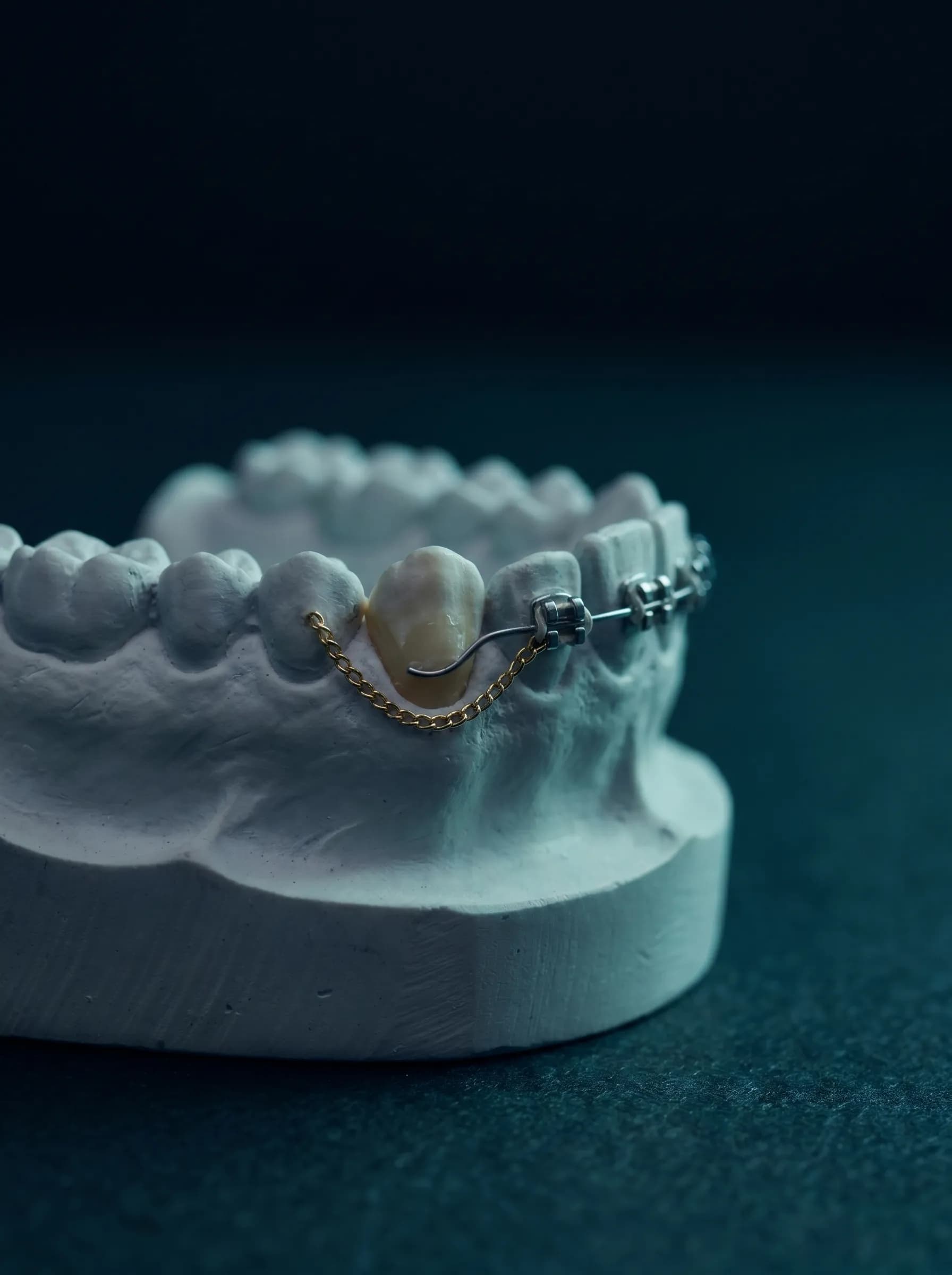
Traction of Impacted Tooth
Plan impacted tooth traction with a protocol — not guesswork.
From etiology and diagnosis to the specific mechanics of buccal and palatal traction — including when to tract, when to extract, and when serial extraction prevents the problem entirely.
If any of this sounds familiar, this is the gap.
"I’m unsure how to plan traction mechanics for impacted canines — timing, force, direction, collaboration with the surgeon."
An impacted canine shows up on the panoramic, and the treatment plan suddenly feels uncertain: open or closed technique? Tract or extract?
A canine over the lateral incisor — one of the most common impaction presentations, and one of the most frequently mistreated.
Without a clear protocol, traction stalls, adjacent roots are put at risk, and the case drags on for years.
You have referred impaction cases away because the canine position made you hesitate.
A clear path through every impaction case — from panoramic to finishing.
The course is Prof. Kleber Meireles’ complete protocol for impacted teeth. It covers the etiologies that create impaction, the diagnostic methods that locate the tooth precisely, the decision between traction, extraction and serial extraction, and the specific mechanics for buccal and palatal cases — every module grounded in documented clinical cases, not theory alone.
- +Diagnose impactions precisely — including palatally displaced canines — before committing to a mechanic
- +Decide tract vs. extract vs. serial extraction with criteria, not instinct
- +Apply the correct mechanics for canine-over-lateral-incisor cases without resorbing the lateral’s root
- +Execute buccal closed traction and palatal traction with documented, repeatable protocols
- +Coordinate timing and technique with the oral-maxillofacial surgeon instead of improvising around the exposure
What is inside, module by module.
01Modules 1–2 — Definition, Prevalence and Etiology
+
Modules 1–2 — Definition, Prevalence and Etiology
What impaction is, how often each tooth is involved, and the etiological factors that produce it.
02Modules 3–6 — Etiologies in Clinical Detail
+
Modules 3–6 — Etiologies in Clinical Detail
Specific impaction scenarios and the factors that complicate traction.
- Impaction of the maxillary second premolar
- Complete impaction of the maxillary canine due to early loss
- Maxillary atresia as an etiological factor in canine impaction
- Apical dilaceration and difficulty in traction
03Modules 7–8 — Diagnostic Methods
+
Modules 7–8 — Diagnostic Methods
Locating the impacted tooth and choosing the approach, with documented cases.
- Diagnostic methods for impaction, with a canine extraction case
- Diagnosis of palatally displaced canines, with a palatal traction case
04Module 9 — Serial Extraction to Prevent Canine Impaction
3 lessons + clinical cases+
Module 9 — Serial Extraction to Prevent Canine Impaction
3 lessons + clinical casesThe interceptive option: when timed extractions prevent the impaction from ever happening.
05Module 10 — Complications Associated with Impacted Canines
+
Module 10 — Complications Associated with Impacted Canines
Root resorption of adjacent teeth and the other risks that make protocol-driven treatment non-negotiable.
06Modules 11–12 — Types of Orthodontic Traction
+
Modules 11–12 — Types of Orthodontic Traction
The traction techniques available and a complete clinical case of buccal closed traction.
07Modules 13–14 — Canine over Lateral Incisor
+
Modules 13–14 — Canine over Lateral Incisor
The common presentation most clinicians mistreat — and the correct mechanics for it.
08Modules 15–17 — Buccal Impaction and Palatally Displaced Canines (PDC)
+
Modules 15–17 — Buccal Impaction and Palatally Displaced Canines (PDC)
When self-correction is possible, what makes PDC different, and the alternative treatment options.
- Buccal impaction — is self-correction possible?
- Palatally displaced canines: what the differences are
- PDC — other treatment options

Prof. Dr. Kleber Meireles.
Orthodontist, international speaker and creator of the KM Orthodontic Diagnosis and Treatment Planning System. Specialist in Orthodontics at USP Bauru, professor and coordinator of postgraduate orthodontics programs, co-creator of the Centrex System published in the Dental Press Journal.
His teaching is built on one premise: cases that used to take four to five years can be resolved in under two — not through talent, but through diagnosis and biomechanics applied as a method.
Built for a specific clinician.
- +Orthodontists who see impacted canines and premolars in daily practice and want a complete protocol
- +Clinicians unsure about traction timing, force, direction or surgical coordination
- +Practitioners who have referred impaction cases away and want to treat them in-house
- +Orthodontists treating children and adolescents who want the interceptive (serial extraction) option
- −General dentists without orthodontic training — the mechanics assume fixed-appliance competence
- −Clinicians looking for a quick tip instead of a full diagnostic-to-finishing protocol
- −Anyone unwilling to coordinate with a surgeon when the case requires it
One price. Everything included.
Secure checkout via Eduzz. Card, installments and international payment supported.
- +17-module video curriculum
- +22 lessons
- +1 year access
Before you ask.
Is the course in English?
+
Yes. All 17 modules and the clinical case documentation are in English, made for an international audience of orthodontists.
How long do I have access?
+
One year of full access to all modules, on any device.
Does it cover both buccal and palatal impactions?
+
Yes. The protocol distinguishes buccal impactions (including when self-correction is possible) from palatally displaced canines, which behave differently and require different mechanics — each with documented clinical cases.
Does it help me decide between traction and extraction?
+
That decision is central to the course. You learn the diagnostic criteria for tract vs. extract, plus serial extraction as the interceptive option that prevents canine impaction in younger patients.
I treat mostly adults. Is the serial extraction content wasted on me?
+
No — it is one module of seventeen. The bulk of the course covers diagnosis, traction types and mechanics for established impactions, which is exactly the adult and late-adolescent caseload.
What if the protocol does not give me a clearer path?
+
Study the protocol, compare it with your current approach, and if it does not give you a clearer path through impaction cases, request a full refund within 15 days.
A clear path through every impaction case — from panoramic to finishing.
A complete 17-module protocol for predictable traction of impacted teeth: diagnosis, traction vs. extraction decisions, and the correct mechanics for buccal and palatal cases — grounded in documented clinical cases.
Mastering Extractions
A clear decision-making framework for orthodontic extractions — face first, then occlusion, then cephalometrics — plus the retraction mechanics, torque control and anchorage management to protect the result.
$147 →EXB · Ebook10 Topics on Extractions
Ten essential topics for extraction decisions you can defend — when to extract, when not to, and how to protect the facial profile when you do.
$27 →DTP · CourseKM Diagnosis & Treatment Planning
The complete four-layer diagnostic protocol. Facial, smile, occlusal and cephalometric analysis integrated into one repeatable system, from Class I to surgical cases.
$697 →