
Guide to Elastics in Orthodontics
Stop prescribing elastics by feel. Use protocols that anticipate the side effects.
Clinical protocols for intermaxillary elastics — when to prescribe them, how to configure them, and how to keep the vertical dimension under your control.
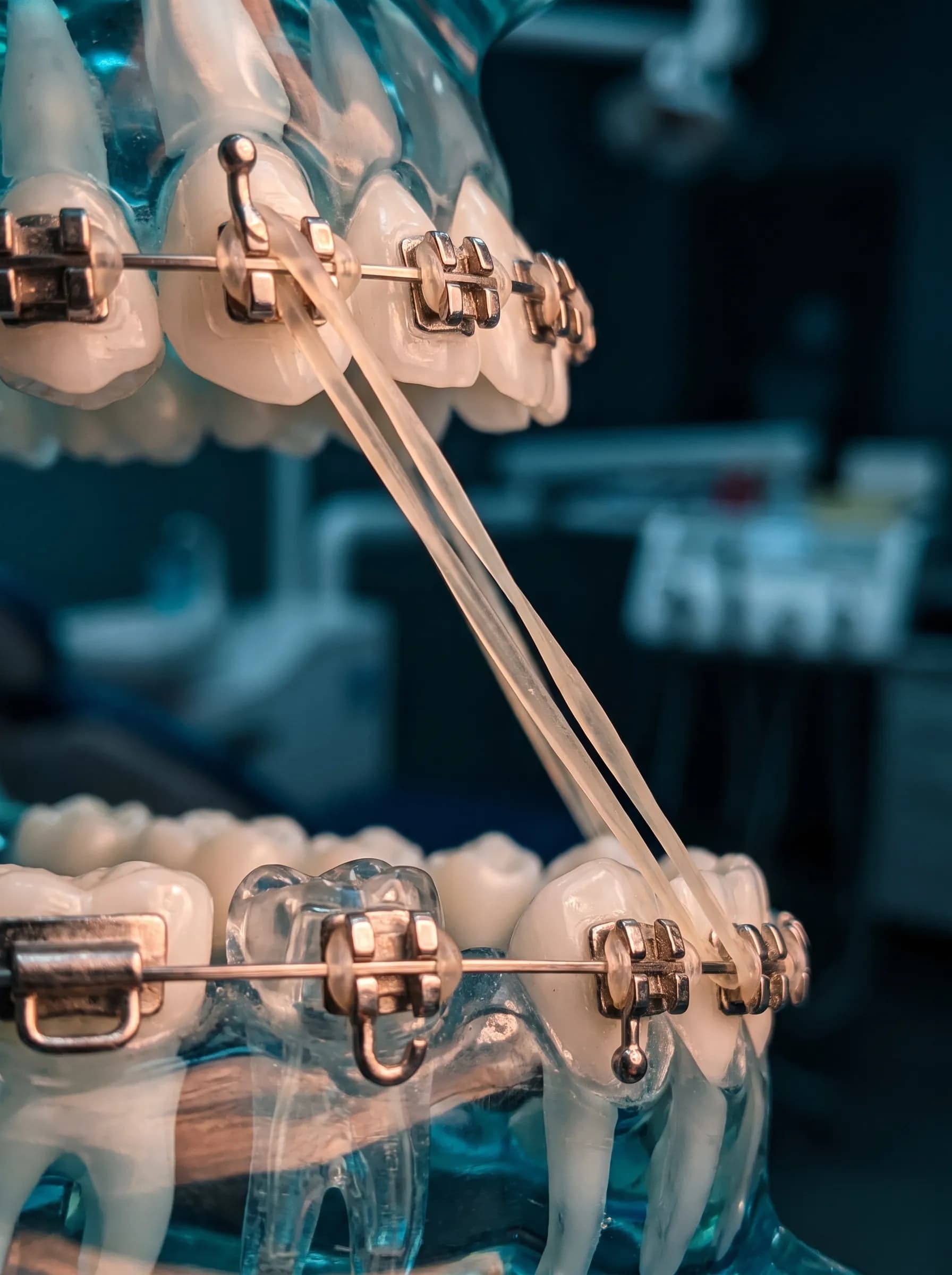
If any of this sounds familiar, this is the gap.
You prescribe elastics from memorized configurations, without knowing what the force system is actually doing to the teeth.
Unwanted extrusion and a vertical dimension that quietly opens — side effects you only notice when the case is already paying for them.
Months lost waiting for a Class II to correct while the case gets stuck in mechanics.
The result of elastic therapy in your practice depends on luck and patient cooperation, not on a defined protocol.
Predictable results from the cheapest mechanics in your practice.
This ebook delivers clinical protocols for intermaxillary elastics: clear criteria for when to prescribe them, how to choose configuration and force, and how to anticipate side effects before they cost you months — so the lowest-cost resource in orthodontics stops producing unpredictable results.
- +Understand the force system behind each elastic configuration instead of repeating recipes
- +Know when elastics will correct a Class II or Class III — and when they will only waste time
- +Anticipate and control vertical side effects, the most common way elastics damage a case
- +Set up force, wear time and cooperation so the result does not depend on luck
Every chapter earns its place.
PDF · 7.0 MBThe biomechanics of intermaxillary elastics
What the force system is doing to the teeth — the foundation for every prescription that follows.
- Force vectors: the horizontal and vertical components of every configuration
- Why two cases with the same elastics finish differently
Elastics in Class II correction
Clinical criteria for prescribing Class II elastics — and for recognizing when they will not work.
Elastics in Class III correction
Configuration, force and timing for Class III mechanics with elastics.
Controlling vertical side effects
Anticipating extrusion and bite opening before they happen, instead of managing them after.
- Which configurations carry the highest vertical cost
- How to protect the vertical dimension during correction
Force, wear time and patient cooperation
Setting up elastic therapy so the protocol — not the patient — determines the outcome.

Prof. Dr. Kleber Meireles.
Orthodontist, international speaker and creator of the KM Orthodontic Diagnosis and Treatment Planning System. Specialist in Orthodontics at USP Bauru, professor and coordinator of postgraduate orthodontics programs, co-creator of the Centrex System published in the Dental Press Journal.
His teaching is built on one premise: cases that used to take four to five years can be resolved in under two — not through talent, but through diagnosis and biomechanics applied as a method.
Built for a specific clinician.
- +Orthodontists who use elastics every week without a defined protocol
- +Clinicians who have watched cases get stuck in mechanics waiting for a correction
- +Practitioners who want to get more from elastics before reaching for costlier resources like mini-implants
- +Postgraduate dentists who want the reasoning behind each configuration, not a recipe list
- −Anyone looking for a complete video course on elastics — that is the Mastering Elastics in Orthodontics course
- −Clinicians who want aligner-specific elastic protocols only
One price. Everything included.
Secure checkout via Eduzz. Card, installments and international payment supported.
- +PDF · 7.0 MB
- +Immediate access · 1 year access
Before you ask.
What format is the ebook, and how do I receive it?
+
It is a PDF (7.0 MB), delivered through the KM Ortho Academy member area immediately after purchase. Read it on any device and your access stays active for one year — download it to keep it.
Is it in English?
+
Yes. The ebook is written in English for an international audience of orthodontists in 131 countries.
Is this too basic if I already use elastics daily?
+
It is written for clinicians who already prescribe elastics. The point is not what an elastic is — it is the force-system reasoning and the criteria that make your prescriptions predictable.
How is this different from the Mastering Elastics course?
+
The course (MEO) develops the full protocol in video, case by case, with Prof. Kleber demonstrating each configuration. This ebook condenses the clinical protocols in written form — a fast reference and a natural first step toward the course.
What if it does not change how I prescribe elastics?
+
If these protocols do not change how you prescribe elastics, request a full refund within 15 days.
Predictable results from the cheapest mechanics in your practice.
Clinical protocols for intermaxillary elastics: criteria for when to use them, how to control side effects, and how to get predictable results from orthodontics’ lowest-cost resource.
Mastering Elastics
Intermaxillary elastics as a system: every clinical configuration from Class II to intercuspation, with force verification, side-effect control and the retention protocol that consolidates the correction.
$197 →APB · CourseAccessible & Practical Biomechanics
The complete KM biomechanics program: force systems, bonding strategy, first- to third-order bends, sagittal corrections and finishing — plus the full bonus stack of courses and ebooks.
$1397 →